I care about art, but I did not loathe The Monuments Men as some would say I am obliged to do. Now in my school days, this difference would have me terribly alarmed. I feared retribution for liking what was derivative or feeling ambivalent toward what was revolutionary...according to others. Who am I kidding? I still fear that difference because it makes me feel like a fraud. It makes me feel like I missed something really important in that one seminar that one day, and now my future is irreparably off course.
But that fear can be calmed by realizing the unique position I have occupied for the past three years: not (just) as a sad little adjunct, but more as a "missionary" of art history to a population of rural neophytes. I do not and cannot approach the history of art as an elitist because I am guiding (not indoctrinating) new art viewers. Think about it. Would Clooney really produce a film that was only for the art elite? Only for those initiated into academia? The man knows how to make a buck or two in Hollywood, so to understand the nature of the film, we have to consider his intended audience.
How do you entertain that audience while telling a true story? How do you make art, and the preservation of it, sexy?
I myself played Lady Gaga and Queen in class last week, but Bill Murray and Cate Blanchett work, too, I suppose. We could surely dismiss this film just on the basis of who is in it: Clooney's clique, acting out his latest sad puppy cause, which happens to focus (to an obsessive extent) on the Ghent Altarpiece. But I liked it. And I understand why certain elements were condensed and why others were overplayed.
In order to immerse a viewer in this true story, you have to make them care about the art. So which art? Everything known to man? I can't even get through that much material in one semester, let alone two hours. So Clooney used particular pieces as emotional foils, if you will. The daring escape of the aforementioned altarpiece opens the film, the abduction of Michelangelo's Madonna in Bruges is somehow more important than the death of a main character, and the torching of Raphael's Portrait of a Young Man is played out like we're watching a hero's unjust execution. I found it to be a good and inevitable device to make the viewer care about the art without requiring at least a bachelor's degree.
Now, if this elicits talk of art as puppies, then so be it. I'll admit to referring to Mona Lisa as a woman, not a portrait. I'll gladly admit to objectifying these objects in an overly sentimental way, because I cannot disconnect the object from the artist I read about in school. It's like meeting Leonardo without a time machine. Yes, it is anthropomorphism, too...but this is a blog written by someone who loves lolcats, mind you. Look for realism elsewhere.
I know there is a segment within the "art world" that does not share in my objectification. There are people out there who will argue that a reproduction is just as good as an original, or bemoan the millions exchanged at Sotheby's for paint on wood or canvas. We all judge value differently. And in this postmodern (or postpostmodern?) age, the idea of the art object itself is questionable. Words are art, as are actions, sounds, and fleeting sights on a screen. Art today can seem immortal, like an digital image, or it can succumb to the ravages of time like latex sculptures dissolving in storage like old rubber bands. Is art something to be owned and stolen and found again, or is it just the idea?
And by focusing on the object, do we necessarily undervalue the idea? The film might not have touched upon the inner workings of art history, and like many Hollywood versions, there are inconsistencies visible to the trained eye: like Matt Damon sauntering along with a canvas in a way no curator would. I think it is both confusing and understandable that character development takes a back seat to the art objects, too. To really get a sense of and learn to care for the Monuments Men themselves, we'd need a different type of film.
We use objects, not just art, to contain, symbolize, and embody ideas like the Monuments Men. Like the shoes in the Holocaust Museum, or the gold fillings found alongside the art in a salt mine, the work of the old masters carries the weight of a loss of human life, the loss of a way of life, and the efforts to save it. At least, that's the parallel I am drawing, whether Clooney meant it or not. And he might as well say he meant it all along, to shoot back at the puppy criticism.
17 February 2014


03 December 2013
crusade
Nothing unites people like a common enemy. And apparently secular people like me make great uniters.
The crusade in my hometown is of a different nature, not violent, but just as zealous. Seriously, our mascot is crusading on teeshirts, now, literally taking up the Cross. There is also a chain dangling down below the fishy fist, perhaps as a symbol of the oppression Christians face today, and have subsequently overcome? I guess the redesign is meant to "put back" the religion thought to have been flushed from the school, but all I see is "Grrr! Jesus!" Not exactly the same message found in the Gospels. It's one thing for an individual athlete to pray or to thank God for that touchdown. It's another to imply that the mascot, the school, the entire community, ascribe to the same beliefs. That's exclusivity, and while it appears to unite, it actually divides.
Four Seasons Graphics has sold these shirts and raised money for a local food pantry. At least some good came of it. What good will come from a bronze statue near campus?
Maybe there is no room for argument here, at least not in legal terms. If the statue is on private property, then it is not a direct statement by the school district. Just as the Muskie teeshirts, sold by a third party, are not official...but both, if the statue is completed, are allowed by the district. No district action, as far as I know, has yet been taken to stop either one.
Some have questioned the legality of altering a school mascot, and I get that. I need to look into trademarks for high schools, because while Ohio State has a choke-hold on their Block O, I do not know of any legal standing regarding the Muskies. In fact, I'm rather nervous having the design's image on my blog now, but you really have to see it to believe it.
All I can say, to (hopefully) wrap up this series of diatribes, is this:
Please, by all means, worship freely and proudly. What you do on Sunday, or what you think/believe/pray any other day of the week, is a personal matter. However, as a teacher or administrator or community leader, you have the responsibility to be inclusive, impartial, and above all, understanding when acting in official capacity. Judging which expressions of faith or opinion are acceptable is not your call. You tripped up on this one, and a student called you out. I wish the ACLU never got involved, but what's done is done. Why invite more controversy? Why repeat the mistakes that led to moving a memorial, and more importantly, losing the trust of students and the community?
In case you forgot, the Latins lost to Saladin in 1187, not even a century after Urban II urged them to take the Cross. The city of Jerusalem is still a hot bed for violence and extremism today; we're like kindergartners refusing to share, only the blocks and dolls are people's homes, places of worship, and lives.
The religious saga in my hometown is far from over; in fact, it's simmering quite nicely. Tell me, what's at your high school's entrance? A sign, a marquee perhaps, an image of your mascot. How about a large bronze sculpture of Jesus? A sculpture of Jesus, albeit on private property, just outside a public school that recently reached a compromise concerning a religious image in the office. That might be what people see when they drive to good old JG, if a community member has her way.
Apparently it isn't a protest, but "a positive memorial to the faith of the community." Hmm, I think NC has some of those already. They're called churches, and $30,000 could do a lot to restore and rejuvenate them. Why pay for a bronze statue, when you can make a positive impact on existing monuments? Better yet, give that money to the students! Books, technology, writing workshops, scholarships! Now that's positive.
Apparently it isn't a protest, but "a positive memorial to the faith of the community." Hmm, I think NC has some of those already. They're called churches, and $30,000 could do a lot to restore and rejuvenate them. Why pay for a bronze statue, when you can make a positive impact on existing monuments? Better yet, give that money to the students! Books, technology, writing workshops, scholarships! Now that's positive.
Two weeks ago, I had some students read aloud excerpts from Pope Urban II's call to the First Crusade. You can read one translation of the speech here. The class squirmed at the graphic violence mentioned to foment religious vengeance. They timidly answered my questions about Urban's motives and persuasion. The promise of heaven is quite a bargain.
But it wasn't just a mission for salvation. It was a land grab; the Latins, as we call Western European Christians at the time, wanted to take territory back from the Muslims. (Territory once held by the Eastern Roman Empire, the Byzantines.) And they held Jerusalem as a Latin kingdom, for a while. It was also a fortuitous distraction from Christian versus Christian violence. Marauding bands of warriors, no longer quite as necessary in a more peaceful Europe, could point their swords eastward. And they practiced their craft on Jewish communities as they made their way to the Holy Land.
Togetherness. Community. Likemindedness. Wrapped in zealotry and stabbing and beheading. How heroic...
 |
Four Seasons Graphics has sold these shirts and raised money for a local food pantry. At least some good came of it. What good will come from a bronze statue near campus?
Maybe there is no room for argument here, at least not in legal terms. If the statue is on private property, then it is not a direct statement by the school district. Just as the Muskie teeshirts, sold by a third party, are not official...but both, if the statue is completed, are allowed by the district. No district action, as far as I know, has yet been taken to stop either one.
Some have questioned the legality of altering a school mascot, and I get that. I need to look into trademarks for high schools, because while Ohio State has a choke-hold on their Block O, I do not know of any legal standing regarding the Muskies. In fact, I'm rather nervous having the design's image on my blog now, but you really have to see it to believe it.
All I can say, to (hopefully) wrap up this series of diatribes, is this:
Please, by all means, worship freely and proudly. What you do on Sunday, or what you think/believe/pray any other day of the week, is a personal matter. However, as a teacher or administrator or community leader, you have the responsibility to be inclusive, impartial, and above all, understanding when acting in official capacity. Judging which expressions of faith or opinion are acceptable is not your call. You tripped up on this one, and a student called you out. I wish the ACLU never got involved, but what's done is done. Why invite more controversy? Why repeat the mistakes that led to moving a memorial, and more importantly, losing the trust of students and the community?
In case you forgot, the Latins lost to Saladin in 1187, not even a century after Urban II urged them to take the Cross. The city of Jerusalem is still a hot bed for violence and extremism today; we're like kindergartners refusing to share, only the blocks and dolls are people's homes, places of worship, and lives.
15 November 2013
It's the wall, not the image, that should be neutral.
 |
| Logo of Al Jazeera America from america.aljazeera.com |
What do you think? How does the image make you feel? Scared? Threatened? Did you just think of terrorism?
Now why did you think that? Some might not be able to get past the common spelling and sound of "Al" in Al Jazeera and Al Qaeda, for instance. I must assure you that this is natural. Especially after 9/11, I cannot blame anyone for that initial, gut reaction. However, I encourage you to recognize why Arabic words and calligraphy stir those feelings, and how you associate a television logo with a terrorist organization.
Then there was that wonderful moment after I played audio of Sura (Chapter) 18 of the Koran. A student raised her hand and said she thought it sounded quite beautiful. She liked the abstract design of the calligraphy and the spiritual qualities that abstract design can impart. Yes.
Then there was that wonderful moment after I played audio of Sura (Chapter) 18 of the Koran. A student raised her hand and said she thought it sounded quite beautiful. She liked the abstract design of the calligraphy and the spiritual qualities that abstract design can impart. Yes.
That's what I mean when I talk about the power of an image. It can scare you, and it can cause you to think beyond the gut reaction. But if images were completely neutral, we wouldn't have much of a visual culture. We wouldn't have the great, iconic images of our own history that express the proverbial thousand words even without any text.
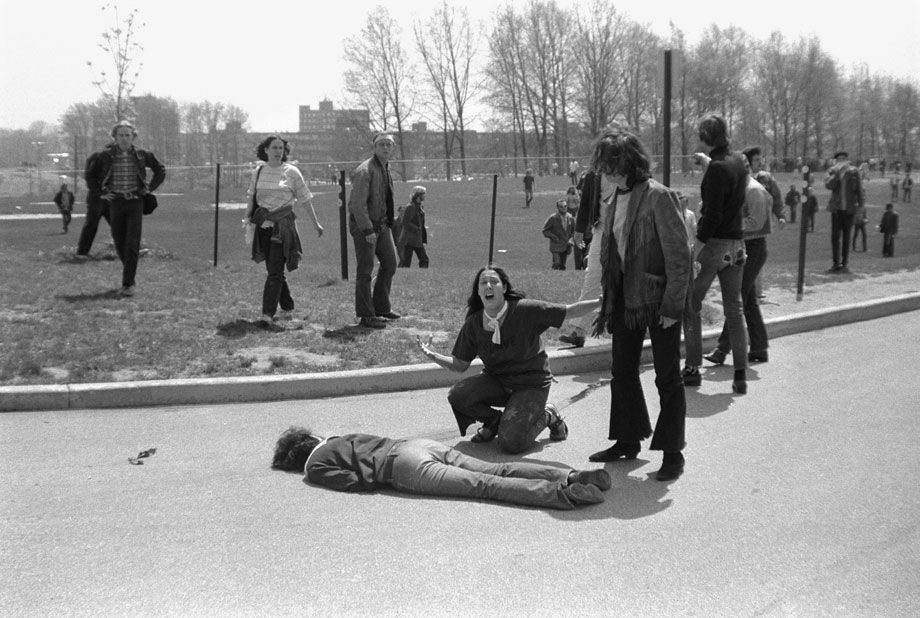 |
| Kent State, 1970 |
 |
| Rosie the Riveter |
But with great power, comes great responsibility. Artists of course are responsible for the images they create, just as viewers are responsible for the images they view. Furthermore, teachers like me are responsible for presenting such images in an academic context, one that nurtures critical thinking beyond gut reactions.
I've written before, pleading for skepticism of facebook memes. That is an example of viewer responsibility. We don't get a "dislike" option, so often the posting of an image is taken as a sign of agreement (unless you accompany it with a rant, like I do). The liking and sharing encouraged on facebook is not invalid as expression, mind you, but it is the expression of gut reactions. Good, bad, beautiful, ugly, agree, disagree...these aren't the products of in-depth analysis, but they are starting points.
Now what happens when the image in question touches on a controversial subject, and the artist is a high school student?
I'm talking about teeshirts, here. Teeshirts that were on display in my high school before the whole Jesus drama ensued. From what I understand of the project, the students were free to pick a topic important to them and create a silk-screen design for that topic. Once displayed to the student body, these teeshirts caused a lot of buzz. Isn't that a good thing? School isn't a protective bubble, especially high school, and what better time to start discussing major issues like gay rights and abortion than when you are young and under the direction of responsible educators?
Again, art has power. Images start conversations, create controversy, and, heck, 100 years ago a ballet started a riot in Paris. A ballet! Go ahead and Google Rite of Spring...
Apparently, some educators at JG are descendants of the Parisian rioters. If I understand correctly, some, but not all, of the teeshirts were taken down after students were unable to keep the discussion civil. Instead of direction, instead of education, the principal chose to blame the art. What a lovely lesson for tomorrow's leaders: "You are just mindless information receptacles. You have no power over your own behavior. You have no responsibility to analyze the issues put in front of you. The art made you do it."
That is a huge problem. That is not realistic. The idea that you can put away or destroy art, or anything you disagree with, is what prevents discussion and compromise. (Are you reading this, Congress?) For all our talk of a free society, I was quite frankly shocked by how a majority of my students not only recognized moments of iconoclasm in our culture, but condoned it when it was the government making the call. Essentially, they wrote on their papers "Some images should be banned, and the government should decide." Scary, right? That's not just a parent refusing to buy Tommy the latest "Grand Theft Auto." That reminds me of Entartete Kunst in Munich, the exhibition of "degenerate" modern art put on by Goebbels and Hitler.
Yeah, I just went there.
Neither side is as bad as Hitler, yet I do not want to see this adversarial approach grow unchecked. Forget riots in Paris; taking away religious objects has led to war. (Fine, go Google the dissolution of the monasteries in 16th century England).
It's a pretty good way to piss people off. No one is dying because their church has been torched, but the school in Jackson did have to pay $95,000 in punitive damages when the ACLU came around. That's money taken out of schools, away from education that should fix this mess. The ACLU swoops in at the very hint of promotion of a particular religion, blind to any other consideration, and JG really left itself open to it. I've seen comments from Christians saying that they do not want to see other religions included in schools. They think a portrait of Mohammed on the wall would be just terrible. Regardless of the fact that there are no portraits of Mohammed! Gah, it's an unyielding viewpoint paired with ignorance that I have a problem with here.
If anything, it boggles my mind how similar the mindsets of both sides are, religious right and secular left. Can we get a third option, here? Maybe a fourth?
Remember, these are the words of an idealist, and my grand solution--a school taking the reins and guiding students as they consider images they don't agree with--is contingent on the school being impartial. And I think it's pretty clear that JG has some partial administrators and educators...not to mention parents and other concerned adults. By equating a mass-produced picture (not even a painting) with your own personal faith, you see yourself attacked. Your way of life is threatened. You bemoan catering to the minority. Well, all that tells me is that our community is not ready to stop blaming the art (or making it your martyr) and start explaining our gut reactions.
How can we teach students to work through big issues if we ourselves are not capable of doing so together?
13 November 2013
picture painting photograph
The local newspaper is reporting on the JG story now, and of course the comments have exploded like an atom bomb. There are my compatriots of course:
All right, my snark is over. Long story short, there has been an image titled The Lord is My Shepherd in my high school since the 1970s. I couldn't really remember it exactly, but my friends have helped me confirm that it is Warner Sallman's work. Frustratingly, the website does not list the painting's date or medium the way other museums and galleries would, but I'd say it is in the vicinity of 1941, the year Sallman painted the Head of Christ. The reproduction of The Lord is My Shepherd in the high school was originally dedicated to a beloved teacher.
I'm still looking into more about her: Dad identified her as Margaret Barnett, a "pillar of Rix Mills Church." (Shout-out to the ancestral Elliott lands...) As a Latin and English teacher, I'm sure she would share my abhorrence of bad grammar. On matters of religion, we'd agree to disagree. Or, as my dear father told a fellow church-going man, "Don't bother talking to Debbie about religion; you won't win that argument." Whatever that means...
Back to a key word, and why my favorite comment is my favorite: reproduction. I highly doubt that the image in JG is an actual painting, and thus does not have the same value as the original (read here, it would not fetch over a million at auction like The Scream), so I hesitate to talk about it in art historical terms. However, I have a new pet peeve: the words picture, photo, and painting (heck, toss portrait in the mix) are not interchangeable. They each have a particular definition. Thus, I use the term picture, image, or reproduction.
But wouldn't it be cool if Jesus took a selfie and posted it on Instagram? It would also be cool if he could just diffuse this whole situation and remind people that whether the image is on the wall in a school or in a church, their faith (that thing protected by the First Amendment) is inside them, not the image. If we all remembered that, maybe we wouldn't be shouting at each other "Your goin 2 hell!!!!1!" and making ourselves look rather silly.
No one took God out of schools. The courts did rule against school-led prayer. Christian or Muslim, it doesn't matter. No one will be led, but they may lead themselves. What's more important to you, really, stamping Jesus on every locker or actually acting like a Christian?
Really this is news ??? Hang a pic of Satan who cares ,just educate the kids ..you religious followers and apposers get fanatical about the dumbest things
There are BIGGER issues that should be addressed way before a picture in the office... Lots of rights violations... prejudicial issues, distinguishing treatment of individual(s) based on their race & community roots…I heartily agree with your sentiment, if not with your grammar and spelling. Then there are these:
No they should put one up on every wall !!!!!!!!!!!!!!!
Amber and Randy may you burn in Hell That's my religion don't like it tuff crap!!!!!!!!!!!!!!!
You stay classy, SE Ohio...classy and crazy. Here's my absolute favorite:
Jesus had his picture taken??? Kodak???
Thank you from the bottom of my heart; I needed that laugh! And the pièce de résistance:
No way.the teacher should be FIRED!!!!!!!!!!
All right, my snark is over. Long story short, there has been an image titled The Lord is My Shepherd in my high school since the 1970s. I couldn't really remember it exactly, but my friends have helped me confirm that it is Warner Sallman's work. Frustratingly, the website does not list the painting's date or medium the way other museums and galleries would, but I'd say it is in the vicinity of 1941, the year Sallman painted the Head of Christ. The reproduction of The Lord is My Shepherd in the high school was originally dedicated to a beloved teacher.
I'm still looking into more about her: Dad identified her as Margaret Barnett, a "pillar of Rix Mills Church." (Shout-out to the ancestral Elliott lands...) As a Latin and English teacher, I'm sure she would share my abhorrence of bad grammar. On matters of religion, we'd agree to disagree. Or, as my dear father told a fellow church-going man, "Don't bother talking to Debbie about religion; you won't win that argument." Whatever that means...
Back to a key word, and why my favorite comment is my favorite: reproduction. I highly doubt that the image in JG is an actual painting, and thus does not have the same value as the original (read here, it would not fetch over a million at auction like The Scream), so I hesitate to talk about it in art historical terms. However, I have a new pet peeve: the words picture, photo, and painting (heck, toss portrait in the mix) are not interchangeable. They each have a particular definition. Thus, I use the term picture, image, or reproduction.
But wouldn't it be cool if Jesus took a selfie and posted it on Instagram? It would also be cool if he could just diffuse this whole situation and remind people that whether the image is on the wall in a school or in a church, their faith (that thing protected by the First Amendment) is inside them, not the image. If we all remembered that, maybe we wouldn't be shouting at each other "Your goin 2 hell!!!!1!" and making ourselves look rather silly.
 |
| Another gem from the comments. You just proved my point, madam. |
Crazy notions of Jesus-coated public schools aside, this is not a simple issue, no matter how
many internet commenters type "end of story" or "period"
after their opinions. Of course, the most immediate argument concerns the
separation of church and state, and I'm purposely avoiding the argument over where the phrase "separation of church and state" originated...let's say it's an interpretation of the First Amendment and move on for now. It's precedent that raises the question: should a public
school display a religious image? Court decisions on this topic point to "No."
However, I would also ask: Does the presence of the image endorse the religion? Should the image's particular location within that school have any bearing on the argument? Should the ACLU be involved on the student's behalf?
However, I would also ask: Does the presence of the image endorse the religion? Should the image's particular location within that school have any bearing on the argument? Should the ACLU be involved on the student's behalf?
To complicate it further (as if parsing
which hallways students use or threatening legal action weren't enough), there
is a very specific function for this image: the commemoration of a teacher.
There are of course such memorials in many school buildings; one internet
comment that caught me as particularly salient brought up the portrait of John
Glenn himself. By displaying and viewing his image, do we become Democrats like
our former Democratic Senator? This, in my mind, is the real issue. What does
the image actually do, and what are the responsibilities
of the viewer and of the institution displaying the image?
Now, since I teach religious art on a
regular basis, I have always been able to frame the religious subject matter in
terms of history and visual culture. And I have for a while been asserting the
ability of images to serve many different functions depending on their context.
Why can schools such as my alma mater not present religious imagery in the same
compartmentalized, educational context? Create an open forum for students to view The Lord is My Shepherd alongside their own images, directed by art teachers, history teachers, English teachers, oh my! Alongside examples of Islamic art, Buddhist art, whatever, just keep the dialogue going. They want to talk about it.
But would that satisfy the students who feel their liberties from religion are infringed? I'm curious...
It took me aback that this new article states that Whaley (the student at the center of all this...stay strong and ignore the burka comments, Allison!) was "initially upset" about the teeshirts. Perhaps that is why one of the ignorami thinks a teacher should be fired over this? Could they be referring to the poor art teacher? That would get me truly riled up.
I had thought that the Dispatch conflated the two issues--Jesus picture and teeshirts--and Whaley's argument was solidly about the picture. I can see, though, how one might lead to the other. The fateful teeshirt project, for which art students chose hot topics like gay rights and abortion, is one of those bigger issues that the school should address. More on that later...
11 November 2013
notes on a town
Before I dive in to the high school drama surrounding religious images and students' rights, I thought I should begin at the beginning: just what is it about New Concord?

Now, the people saying these things are not necessarily from New Concord. But New Concord residents who care about what is going on in their community ought to ask themselves why there is such an aggressive reaction to the question "Should a public school have a religious image on the wall?" Fear. The knowledge that you and your sect are not in complete control. Yet in their anger and fear, as in the film, they show their true colors. If only she'd be quiet, right? If only she's stop making a scene, everything could stay the same.
While I was describing the issues to a student of mine, she said "Nothing bad ever happens there, and everyone is so nice." New Concord is our Mayberry, our Pleasantville. It's a quaint college town on the outskirts of Appalachia. And everyone is so nice.
Except the person who robbed the drug store at gun-point last year. True, that sort of thing seems a lot more frequent in a place like New York City; everyone asked me "aren't you scared about moving there?" I think this is true of all rural areas; we have this delusion that crime only happens in cities. That there is an invisible barrier between us and the gangsters and drug dealers and burglars. It was last year that I really (really) missed having my dog Zeke around, because there were several burglaries in the little town near the farm. Zeke would have bitten a burglar's legs off to protect me, and I missed that reassurance. I find it really strange how "country" it is to have dogs around, to have guns in the house for protection, then in a brilliant moment of cognitive dissonance, to assert that nothing bad happens here because we're country folk. We obviously feel the need to prepare for something.
The security director at the campus where I teach made this very important point: banish all thoughts of New Concord as a real-life Pleasantville from your mind. Do it now! Have you seen the film titled Pleasantville? What is pleasant is not always pleasing.
Aside from having a magnificent soundtrack, the film is very instructive for people trying to understand what is going on in New Concord. It, like Pleasantville, is a place where tradition reigns, and change is frowned upon. And I'm not talking about new construction--with the university on the hill and the new bank on the corner, cosmetic change is welcomed, so long as it's clad in quaintness and ornamental brick. As a kid, it really did feel like the end of Main Street looped back to the beginning again. An endless loop of small town goodness. A loop I was, as a country kid, often excluded from. Sometimes it takes an outsider, though, to make things happen.
What happens to Pleasantville? Outsiders change it from black & white to color. From conformity to diversity. From narrow-mindedness to open-mindedness. I think that same change can happen in New Concord, but not if grown men and women get their panties in bunches over a student questioning a picture of Jesus. Not if they call her un-American or tell her to get out.
Will taking the picture down negate all that is actually good about the community? No. And allowing students to debate (in a civil manner) controversial issues doesn't take away from the fact that New Concord is a pretty good place in which to grow up. The debate will make it better. It will diminish the false pretenses that rural communities are in these protective bubbles that liberal secular elitists are trying to pop. No, you don't live in a vacuum. Sorry.
The idea of Pleasantville is dependent upon conformity, and conformity cannot coexist with American liberty. The process of breaking down conformity is painful, I know, and those most discomforted by change will fight back with unkind words and judgments. I pity them for using Christianity as a shield. I'm disappointed in them for showing a young adult such disrespect. Above all, I admire the student for attempting what I could never do.
08 November 2013
religion on the brain
I have a confession: I'm addicted to The Tudors, and not because it's a Showtime boink-fest. As a student of history, I love to see certain events brought to life, and I love dissecting the writers' liberties taken with historical figures even more. Aside from Henry's many wives and affairs, I think the series made manifest the Reformation and the religious struggles on both sides--Catholic and Protestant--in brilliant fashion.
Along with indulging my Tudors craving, I have also been teaching religious art in my class these past few weeks. In fact, more than one student has, privately, expressed surprise that I put images of Jesus Christ and churches and pages from the Koran up on the screen in front of them. They were surprised, not because they were offended by the images or my lectures, but because they expected others to be offended. How unusual, I thought. Then again, I've been trying to goad them all into making their first impressions known, in order to teach them how first impressions often need to be modified. Essentially, I too was betting at least someone would be offended; I played audio of someone reading from the Koran, for Pete's sake. More on that another time...
Perhaps it is wrong of me to expect some students to be ill-informed about Islam or Christianity, considering my own fear of being pegged a Christian simply because of where I grew up and the family I belong to. It's all so timely, to be teaching religious art and immersing myself in religious history when I came across the article about my high school's current troubles. Of course I immediately shared the article with a lengthy rant. It was liked by a very diverse sampling of my friends, both conservative and liberal. I take this as a sign of success, up to the point that I trust no one has made any assumptions about my religious views.
Has humanity changed much in the last five hundred years? In the last thousand? The more I read, and the more I teach it, the more I believe history is repeating itself. In the 16th century, it was reformers like Martin Luther versus the papacy. Today, it's the religious right versus...well, secular heathens like myself. That's what Bill O'Reilly would call me. I've referred to myself as agnostic in the past, never atheist (that term has a PR problem, for sure...more like getting-religious people-to-understand problem). I think I need a new label these days, so now--maybe it's the historical drama binge talking--I call myself a Humanist.
Humanists value learning above all else. Learning leads to improving oneself and one's community. The humanism of the 16th century highlights, for me, a time in history when great minds realized that learning (particularly of Classical culture once deemed too pagan), is not contrary to religious practice. It is, however, contrary to religious dogma.
I cannot let go of the issues presented in the article. I cannot, as an art historian, abide by the removal of a potentially educative image from a school. I cannot simply join the side of the ACLU, the perceived "liberal secular progressive" side. I cannot stomach the calls for prayers for JG, as if the school is battling Satan and his legions. I'm trying to present a nuanced view of a very complicated situation in my own hometown. So, I want to ask my high school: Dear JG, are you spreading dogma, or are you encouraging learning?
Insisting that New Concord is a Christian community is dogmatic. Not to mention exclusionary (and that's where you bump into the First Amendment clause). Trumpeting the commemorative nature of a religious image is a pathetic attempt to cling to that dogma while hiding from it at the same time. Berating students who have raised their concerns about the constitutionality of a religious image in a public school, telling them to "get out of my country," is just plain wrong. So within the next few weeks, I hope to do some research on the side about the many issues at play in my high school today. And I hope I clarify the points I made in my rant, making plain that I am not on Team Christianity, and not really on Team ACLU. I'm on Team Let-the students-have-a-voice.
24 October 2013
dissing the dissemination of ignorance
 |
| From the Facebook community oddly titled "PATRIOT" (sic). |

[WARNING: Knowledge follows...]
Now, I'm all for patriotism. I'm all for voters being aware of the values and views of the candidates they support. This, however, does not educate voters. It sucks their brain cells dry. The page that posted this (although I cannot cite them as the originators), simply says "PATRIOT - One who loves, supports and defends one's country." It's a nice thought, but again...how does comparing an American president to Hitler support or defend the United States?
Silly me, I don't even need to bother with that question. This particular instance of Obama=Hitler is predicated on the (sadly) bold statement: "Only two people in history had their own symbols." This is where I can tear this whole thing to shreds. And others have attempted it within Facebook comments, only to be called names, naturally.
Call me art historian. That means I am fully capable of denouncing the statement as blatantly false. Point number one: "Only two people?" Please. The Queen of England has a symbol--her coat of arms. Caesar had his Eagle. But let's cut to the quick here. I'm talking about a man from a backwater of the Roman Empire, born approximately in the year 1 AD. You might know him as Jesus of Nazareth, Jesus Christ, or simply Jesus, your Lord and Savior. They say "know your audience," and I know that the main audience for tripe like the meme above tend to be religious. Here are just three symbols used within the same scope of "history" the meme claims:
 |
| Chi Rho Iota |
 |
| Christian Cross |
 |
| Ichthys (Fish) |
So let's examine these symbols and see if they fit the bizarrely ominous tone of the meme. The Chi Rho Iota, which combines the first three Greek letters of the name Christ, is credited for the emperor Constantine's victory at the Milvian Bridge. He had a vision of the Chi Rho Iota in the sky that convinced him to use the symbol as his standard. Constantine went on to declare Christianity a legal religion in the empire, ending persecutions of Christians. Not exactly Hitler material. The Ichthys, also Greek, is a simple fish that Christians would use to identify themselves to fellow Christians before the religion became dominant in the Roman world. It too is based on the Greek name of Jesus: Iesus Christos, Theo Yios, Soter (Jesus Christ, Son of God, Savior). Again, an innocuous image with a great history. All it takes is a little reading.
Now the Cross, we can really sink our teeth into that. It has also become a major symbol for Jesus and Christianity as a whole, but Early Christians actually preferred the Chi Rho Iota and Ichthys to the Cross. To a Roman citizen, it would be like looking at an image of an electric chair. Crosses were standard execution equipment for political dissidents, and the cross as a symbol, the Crucifix in particular, was quite rare in Christian art before the 5th century AD.
My point is that symbols are not just drawings or letters combined in clever designs. They have many layers of meaning. Some meanings are positive, while some meanings are very negative, like the Cross would have been to the Romans. The Swastika also has many layers. Before it was appropriated by the National Socialist Party in the 1920s, the Swastika was a sacred symbol to Hindus and Buddhists, among other eastern religions. In Sanskrit, svastika means "good fortune," and today you can see it on statues of Buddha. Hardly a sign of impending genocide. Send Heinrich Schliemann to do archaeological work in Turkey, though, and boom, this poor symbol is distorted into an image of Aryan purity. Good luck turns into bad juju when Germans are looking for their ancient ancestors.
Back to the meme version of the Swastika: I think the creator of this image is noticing some basic geometric coincidences. The circular forms of both make for a great comparison; they must mean the same thing! It's a pretty big leap, though, from form to politics. They make that gargantuan jump because they add their own negative layer to Obama's campaign symbol. In it they see progressive, gun-grabbing Fascism/Socialism/any scary -ism you can think of. No symbol is created in a vacuum. We influence them as much as they influence us.
Symbols are all around us. We are bombarded by images that stand for ideas, people, and places, so it is completely ludicrous to narrow the entire visual history of the human race down to two symbols to make a faulty political point. Spreading this as a meme on social media is tantamount to shouting lies on a street corner: "2+2=5! Why? Because Obama is a Muslim!" It doesn't take much to stop and think about what you find online. So I end with a plea: please think before you share such memes in the future. Be skeptical, especially when someone is making a Hitler comparison.
Subscribe to:
Posts (Atom)